
Competitive Score
See how you stack up against the businesses competing with you in Google's map results - who ranks higher, who has more reviews, and where you have room to pull ahead.
In your app: /competitive-score/
The Competitive Score grades how you're doing relative to the businesses you compete with directly in Google's local search results. It's not a comparison to every business in your industry nationally - it's about the specific competitors who show up on the same map searches as you, in your service area. A rising Competitive Score means you're gaining ground on the businesses your potential customers are comparing you to.
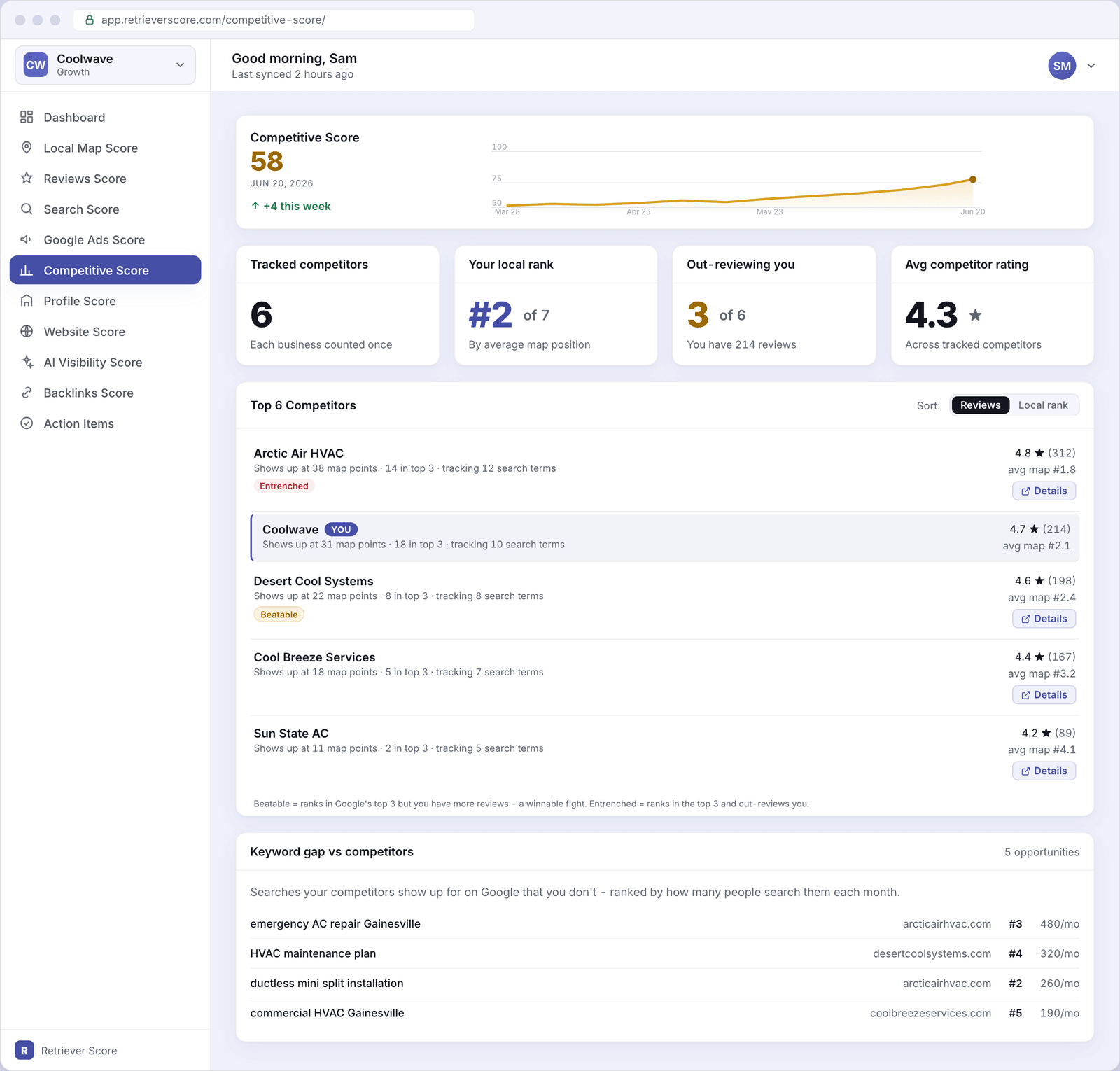
What's on this screen
Score timeline
The large number at the top is your Competitive Score - a 0-to-100 grade for how well you're doing against your local competition. The line chart shows how it has moved over the past 12 weeks. Because this score depends on what your competitors are doing as much as what you're doing, it can shift even when you haven't changed anything. A competitor gaining reviews or improving their map presence will affect your score too.
Tracked competitors
The total number of competitors Retriever Score has identified in your market. These are businesses that show up in Google's map results for the same searches as you. We find them automatically by monitoring which businesses appear alongside you in your tracked search terms - you don't need to name them yourself.
Your local rank
Where you stand in the competitive field, by average map position. If this reads "#2 of 7," it means one competitor consistently ranks higher than you in the map results, and five rank lower. This is the clearest answer to the question "am I winning?" - and the number to watch over time.
Out-reviewing you
How many of your tracked competitors have more Google reviews than you do. Review count is one of the biggest factors in map rankings - Google tends to trust businesses with more reviews. If three competitors are out-reviewing you, growing your own review count is likely one of the fastest ways to improve your competitive position. See your Reviews Score for tools to do that.
Avg competitor rating
The average star rating across all your tracked competitors. Compare this to your own rating on the Reviews Score screen. If you're above the average, that's an advantage worth protecting. If you're below, improving your response rate to reviews and addressing negative feedback is worth prioritizing.
Competitor list
The main section of this screen is a sortable list of every competitor we track. Your own business appears in the list at its true position - highlighted with a "You" badge - so you can see exactly where you sit relative to the competition.
Each competitor row shows:
- Their star rating and review count - the reputation signal Google weighs heavily.
- Their average map position - how high they typically rank when they appear in search results.
- A threat label when one applies. "Entrenched" means they rank in Google's top 3 AND have more reviews than you - a tough fight. "Beatable" means they rank in the top 3 but you have more reviews, which suggests you could push past them with stronger map presence.
- A Details button that opens the full competitor deep-dive - their profile, the exact search terms they contest with you, their map coverage, and the ads they're running. See Competitor details.
Use the sort toggle above the list to switch between sorting by review count and by local rank. Sorting by rank is useful when you want to see who's beating you on the map; sorting by reviews shows who has the strongest reputation.
Keyword gap vs competitors
A table of searches your competitors rank for in Google's results - but you don't. These are organic search terms (website rankings, not map results) where a competitor has a listing and you have none. Each row shows the search phrase, which competitor dominates it, their current position, and how many people search for that phrase each month. High-volume terms where a competitor ranks in the top 5 are the best opportunities to act on - adding pages or content targeting those phrases can help you capture that traffic over time.
How the score is calculated
The Competitive Score combines several signals: your map position relative to your competitors across your tracked searches, how your review count and rating compare to the field, and how consistently you appear in the map results where they appear. A business that ranks well, has a strong review count, and shows up reliably across its service area will score higher than a business that ranks highly in one neighborhood but is invisible in another.
Start with "Beatable" competitors. If the list shows a competitor tagged "Beatable," that's your best near-term target. They're already ranking in Google's top 3, which means the market wants what they offer - but you have more reviews than they do. Improving your map coverage (see Local Map Score) and keeping your review count growing are usually enough to pull ahead of a beatable competitor within a few weeks.
What to watch over time
- Your local rank number. Is it going up (you're improving relative to the field) or down (a competitor is pulling ahead)? A change here is the most direct signal of your competitive standing.
- New competitors appearing. Retriever Score picks up new businesses as they start showing up in your map searches. A new entrant in the list is worth clicking into to understand how strong they are.
- The "out-reviewing you" count. If this number is growing, review generation should be a priority. See Reviews Score for your current standing and tips.
- Keyword gap opportunities. A high-volume search where a competitor holds a top-5 ranking and you have nothing is a content or website gap worth addressing. Check your Search Score to see how your overall keyword rankings are trending.