
AI Visibility Score
More and more people are asking ChatGPT and Google's AI which plumber, dentist, or HVAC company to call. This score tracks whether those AI assistants are recommending you.
In your app: /ai-visibility-score/
When someone asks an AI assistant "Who's the best HVAC company near me?" or "What are some good dentists in [city]?", the assistant picks a few businesses to name - and the people who asked are very likely to call one of them. Unlike a regular Google search where you can see every result, AI assistants give a short list and most people just go with it. The AI Visibility Score tracks how often you make that list - across ChatGPT, Claude, and Google's built-in AI answers.
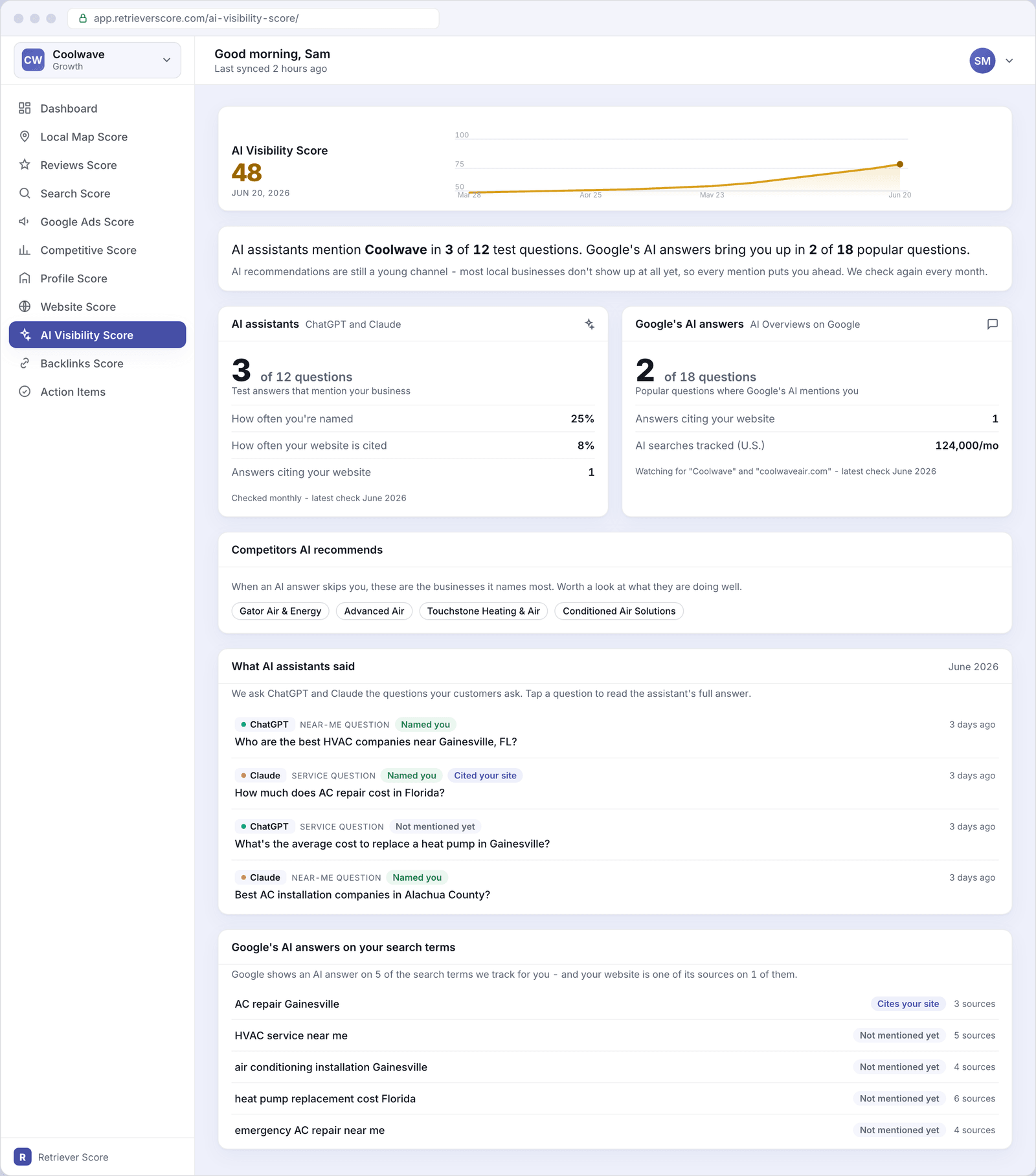
What's on this screen
The screen has several sections. Here's what each one tells you.
Score timeline
The large number at the top is your AI Visibility Score - a 0-to-100 grade for how visible your business is across AI assistants and Google's AI answers. The line chart shows how the score has changed over the past 12 weeks. The color follows the same system as the rest of Retriever Score: green (80-100) is strong, blue (60-79) is good, gold (40-59) is fair, and red (below 40) needs attention.
This score is newer than the others - AI assistants became popular for local business recommendations in 2025-2026, so scores are building from a lower starting point across the industry. A rising trend is what matters most right now.
Summary card
Just below the timeline, a plain-English summary tells you the most important thing: how often AI assistants are naming your business, and whether Google's AI answers are bringing you up too. If you're not showing up yet, the card also says so plainly - along with a reminder that most local businesses aren't showing up yet either, so getting any traction at all puts you ahead of most competitors.
AI assistants card (ChatGPT and Claude)
This card shows results from the test questions we ask ChatGPT and Claude - the two most-used AI assistants for business recommendations. Each month we send them a set of questions that match what your customers actually ask: things like "Who are the best HVAC companies near [city]?" or "What's the average cost to replace a heat pump in [state]?"
The large number at the top of the card shows how many of those test questions led to an answer that mentioned your business. Below that:
- How often you're named - the percentage of all test questions where an AI assistant mentioned your business by name.
- How often your website is cited - some AI answers include source links. This is the share of questions where the assistant linked to your website.
- Answers citing your website - the raw count of answers that linked to you.
Google's AI answers card
When you search on Google, a highlighted summary often appears at the very top of the results - that's a Google AI Overview. It answers the question directly, often without the person clicking any link. This card tracks how often those Google AI answers mention your business or link to your website, for the popular questions people ask about businesses like yours in your area.
- Questions where Google's AI mentions you - the count of popular local searches where Google's AI answer named you or cited your site.
- Answers citing your website - when Google's AI links to your site as a source, it's a strong signal of authority.
- AI searches tracked - the total monthly search volume for the questions we monitor, so you can sense the scale of the opportunity.
Competitors AI recommends
When an AI assistant's answer skips you, it usually names someone else. This card shows the businesses that AI assistants mention most often in your category and area. It's worth looking at what these competitors are doing differently - their website content, their review volume, and their overall online presence are usually the factors that push them into AI answers ahead of you.
What AI assistants said
A list of the actual questions we asked ChatGPT and Claude, along with each answer's outcome. Each row shows which assistant answered, what kind of question it was, and whether you were named or cited. Tap any row to read the full answer the assistant gave - so you can see exactly what it said, which sources it cited, and who it recommended instead (if it skipped you).
The outcome chips on each row mean:
- Named you - the assistant mentioned your business by name in its answer.
- Cited your site - the assistant included a link to your website as a source.
- Not mentioned yet - your business didn't appear in this answer. That's the most common result for now - and it's the gap this score helps you close over time.
Google's AI answers on your search terms
This card lists the search terms we track for your business where Google shows an AI Overview at the top of the results. For each term, it shows whether your website is one of the sources Google's AI is pulling from. Tap a row to see which websites Google is citing for that search - those are the sites you'd want to match or beat in terms of content quality and relevance.
If your website isn't cited yet on any of these terms, that's actually a clear opportunity: writing helpful, specific content on your website about those topics is the most direct path to getting picked up as a source.
Why AI visibility matters now
A growing number of people - especially younger customers - now start their search for a local service by asking an AI assistant rather than typing a Google search. They ask conversational questions and trust the answer they get. If your business isn't in that answer, you don't get considered. If it is, you often go straight to the top of the person's call list.
The businesses winning on AI right now are mostly the ones with strong fundamentals: lots of positive reviews, a complete Google Business Profile, a fast and helpful website, and content that directly answers the questions customers ask. Those are the same things that help every other score in Retriever Score - so improving across the board lifts your AI visibility too.
Look at the Google AI searches your competitors are being cited on. Tap any term in the "Google's AI answers on your search terms" card to see which sites Google is pulling from. If a competitor's site appears there, look at that page - the depth of content, the way they've structured their information - and write something even better on your own site. That's the most reliable way to earn a spot as a source.
What to watch over time
We check AI assistants and Google's AI answers once a month (AI data updates more slowly than website or reviews data). Month over month, watch for:
- The "named" count rising - more test questions where an AI assistant mentions you. Even going from 0 to 1 is a real signal that your presence is registering.
- Your website moving into "Cited your site" status on any question or search term. Citations from AI assistants are early evidence that your content is being seen as an authority source.
- Competitors falling off the recommendations list - if you see a competitor disappear from the "Competitors AI recommends" card, it often means they've slipped in some area (reviews, website quality) and you have a window to take their spot.
- New search terms appearing with Google AI Overviews - as Google expands its AI answer coverage, more of your tracked search terms may develop AI answers. Each new one is a new opportunity to earn a citation.
AI recommendations are a brand-new channel for local businesses. It is completely normal to have a low score here in 2026 - the vast majority of businesses do. The score's job right now is to give you an honest baseline and show you the trend over time, so you can see whether your online presence improvements are starting to register with AI systems.